显示标签为“Urine bag”的博文。显示所有博文

2016年3月20日星期日

Care of the Urine Drainage Bag and Leg Bag


The Foley catheter is a tube that helps drain urine from the bladder. It is used by some patients who have had urological or gynecological surgery, or who have a condition that makes urination difficult.

Describe me
The urinary  catheter is placed into the bladder through the urethra, the opening through which urine passes. The catheter is held in place in the bladder by a small, water-filled balloon. In order to collect the urine that drains through the catheter, the catheter is connected to a bag. It is either a regular (large bag) drainage bag or a small leg bag.

If you have a urinary catheter, you will use the larger drainage bag at night while you are sleeping. You can use the leg bag during the day..

Attaching or removing a leg bag
The leg bag is attached to your leg and allows you to move around more easily. Because the bag is hidden under your clothes, it may also make you feel more comfortable about the catheter.


To attach or remove a leg bag, you will need the following materials:

Clean leg bag(s)
Leg straps or tape
Cotton balls and alcohol pads
White vinegar
Water and a towel
Regular (large) drainage bag
To attach or remove the leg bag:

Wash your hands with soap and water for 15 seconds.
Empty the large drainage bag. The different types of drainage bags open in different ways: a drain spout that you remove from its sleeve, a clamp that you open to the side, or an opening that you twist. Whichever method you use, be sure to not touch the tip when you let the urine flow out of the large drainage bag into the container or toilet.
Place a towel under the connection between the catheter and the bag.
Pinch off the soft rubber tube (the catheter tube) so that urine doesn't leak out.
Disconnect the urinary  catheter tube from the current large drainage bag with a twisting motion. Keep pinching the soft rubber tube (the catheter tube) so that urine does not leak out.
Be careful not to pull on the catheter. Place the old large drainage bag on the towel.
Prepare to place the leg bag in the catheter tube from which you just disconnected the large drainage bag. Remove the protective coating from the tip of the leg bag drainage tube. (Save this tip to use later when you change back). Clean the tip with an alcohol pad, wiping away from the opening to avoid getting the tube dirty. Insert the tip in the catheter tube.
Fasten the straps of the leg bag to your thigh. Secure the catheter itself to your leg with tape. Be sure to leave some slack in the catheter so that you don't put too much pressure on the bladder, urethra, and other parts of the body. Don't fasten the straps on the leg bag too tightly to your leg, as that may interfere with your circulation. If the leg strap gets dirty, wash it with soap and water.
Emptying the leg bag
Please note that because a leg bag is smaller than a regular drainage bag, it will have to be emptied more frequently.

Empty the leg bag when it is half-full, or at least twice a day.
Place a large plastic or metal container on the floor next to you. You may also empty the urine into the toilet. The nurse may give you a container to use at home.
Wash your hands with soap and water.
The different types of drainage bags open in different ways: a drain spout that you remove from its sleeve, a clamp that you open to the side, or an opening that you twist. Whichever method you use, be sure to not touch the tip when you let the urine flow out of the urine bag into the container or toilet.
When the bag is empty, close the clamp or twist on the cap on the leg bag.
Wash your hands with soap and water.
Write down how much urine was in your bag, if your caregivers have asked you to keep a record.
It is a good idea to occasionally change your leg bag from one leg to the other. The best time to do this is right after you shower.

Cleaning the bag
When you are ready to go to sleep, change out the leg bag and put on the drainage bag. Rinse out the leg bag with 1 part vinegar and 3 parts water. Soak the bag for 20 minutes. Rinse the bag out with warm water and hang it up to dry.
In the morning, take off the drainage bag, put on the leg bag, and clean out the drainage bag the same way.
Clean your leg bag every day and replace it whenever your doctor tells you to. This is usually once a month.
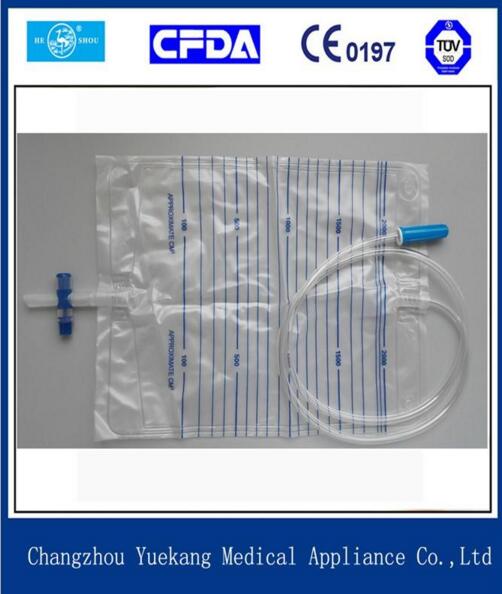
urinary drainage bag cover bedside urine container

2016年1月24日星期日

Urine drainage bags


Urine drainage bags collect urine. Your bag will attach to a catheter (tube) that is inside your bladder. You may have a catheter and urine drainage bag because you have urinary incontinence (leakage), urinary retention (not being able to urinate), surgery that made a catheter necessary, or another health problem.

How Your Leg Bag Works
Urine will pass through the catheter from your bladder into the leg bag.

Your leg bag will be attached to you all day. You can move around freely with it.
You can hide your leg bag under skirts, dresses, or pants. They come in all different sizes and styles.
At night, you will need to use a bedside bag with a larger capacity.
Where to place your leg bag:

Attach your leg bag to your thigh with Velcro or elastic straps.
Make sure the bag is always lower than your bladder. This keeps urine from flowing back into your bladder.
Emptying Your Leg Bag
Always empty your bag in a clean bathroom. DO NOT let the bag or tube openings touch any of the bathroom surfaces (toilet, wall, floor, and others). Empty your bag into the toilet at least two or three times a day, or when it is a third to a half full.

Follow these steps for emptying your bag:

Wash your hands well.
Keep the bag below your hip or bladder as you empty it.
Hold the bag over the toilet, or the special container your doctor gave you.
Open the spout at the bottom of the bag, and empty it into the toilet or container.
DO NOT let the bag touch the rim of the toilet or container.
Clean the spout with rubbing alcohol and a cotton ball or gauze.
Close the spout tightly.
DO NOT place the bag on the floor. Attach it to your leg again.
Wash your hands again.
Changing Your Leg Bag
Change your bag once a month. Change it sooner if it smells bad or looks dirty. Follow these steps for changing your bag:

Wash your hands well.
Disconnect the valve at the end of the tube near the bag. Try not to pull too hard. DO NOT let the end of the tube or bag touch anything, including your hands.
Clean the end of the tube with rubbing alcohol and a cotton ball or gauze.
Clean the opening of the clean bag with rubbing alcohol and a cotton ball or gauze if it is not a new bag.
Attach the tube to the bag tightly.
Strap the bag to your leg.
Wash your hands again.
Cleaning Your Leg Bag
Clean your bedside bag each morning. Clean your leg bag each night before changing to the bedside bag.

Wash your hands well.
Disconnect the tube from the bag. Attach the tube to a clean bag.
Clean the used bag by filling it with a solution of 2 parts white vinegar and 3 parts water. Or, you can use 1 tablespoon of chlorine bleach mixed with about a half cup of water.
Close the bag with the cleaning liquid in it. Shake the bag a little.
Let the bag soak in this solution for 20 minutes.
Hang the bag to dry with the bottom spout hanging down.
When to Call the Doctor
A urinary tract infection is the most common problem for people with an indwelling urinary catheter.
 urinary drainage bag cover bedside urine container

2016年1月19日星期二

How Ostomy Bags Work


An ostomy is a surgical diversion of the digestive or urinary system that bypasses normal elimination and provides for evacuation of waste products directly through an opening in the skin called a stoma. Because the waste products drain involuntarily, there must be some means of capturing them and storing them. This is accomplished by using small pouches called ostomy bags. These, along with several necessary ostomy supplies, make it possible to function with an ostomy.

Ostomy bags are of two types: colostomy bags and urostomy bags, the former for the digestive system and the latter for the urinary tract. In all cases, they attach to the stoma by a flange which has an adhesive that secures the bag to the skin. Some ostomy bags are one piece, with an integral flange; some are two pieces, where the flange stays attached to the stoma and the bag is detachable.

Colostomy bags are either closed-end pouch or open-end pouch types. Open-end pouches are used when the colostomy is high on the colon and watery, irregular feces are excreted. The bottom can be opened and the waste drained. A closed end pouch is designed to be filled and discarded. A uroscopy bag can be one-piece or two pieces as well, but it generally includes a drain for emptying the urine. Ancillary ostomy products include waterproof tape to seal the edges of the flange, and night drainage systems that attach to the drain of a urostomy bag and allow the patient to sleep undisturbed.
urine bag stand bag urine collection leg bag urine